The BusinessOS method
BOS starts with the work happening now.
We take one real case, trace how it moves through the team, and build something concrete that can be corrected on the next run.
One real case · a trace of the work · the next test

Where does the handoff break?
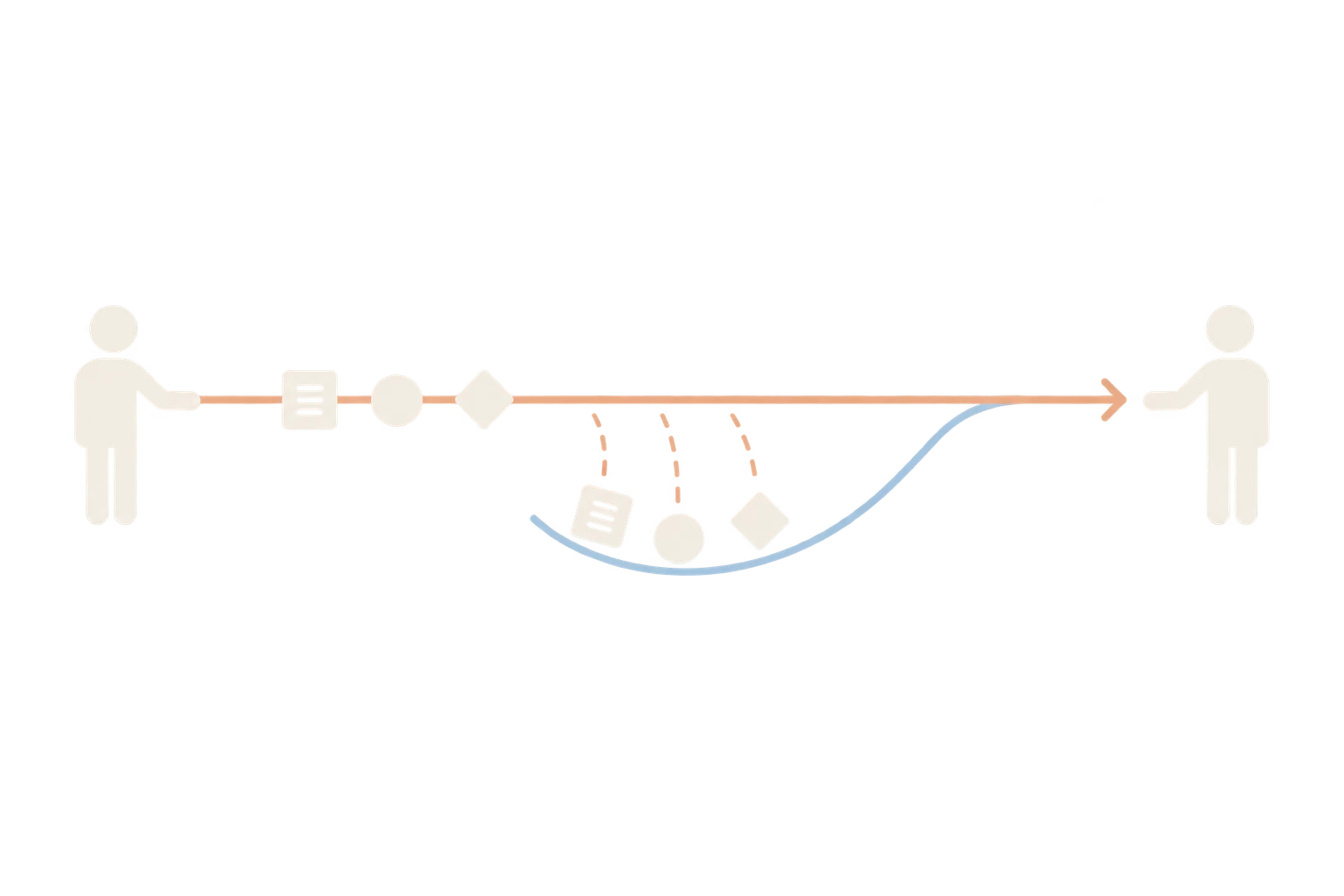
The work moves on. Does its context travel with it?
One case may start in a message, move through a file, a decision, an exception and another person's hands. If each handoff requires someone to reconstruct what was already decided, that one run is worth examining. Sometimes a clearer owner or one better step is enough.
01 / One real task
Show the work in front of you.
We choose the intended result and observe one run with the right permissions and a clear scope. If live work cannot be shown, we follow a recent completed case and label it as a retrospective account.
- InputWhat starts the work?
Goal, trigger, source versions and missing information.
- WorkWhat happens along the way?
People, actions, decisions, exceptions and handoffs.
- Accepted resultWhat is received?
The actual output, its recipient and acceptance criteria.
02 / Evidence status
Every claim has a source and a boundary.
The map is an initial reading of a specific case. We mark what we saw, what someone told us and what remains unresolved.
- Observed
- In this run, the file reached the next person.
- Reported
- The worker says they usually send it earlier.
- Interpretation
- This difference may be due to the lack of an up-to-date version of the template.
- Hypothesis
- A list of required inputs and their current formats might help with the next handoff.
- Unknown
- We do not yet know who approves the exception.
03 / First working model
Start with a small draft people can correct.
From the agreed trace, we prepare a few simple candidates: a task card, a handoff map or a list of gaps. The person doing the work may discard them, choose one or combine parts. They correct a concrete version by pointing to the difference and its rationale.
Previous claim → correction → rationale → scope → owner → version
- Previous claim
- Correction
- Rationale
- Scope
- Owner
- Version
04 / Local trial
The next run tests the map.
An authorized owner confirms the local version and its limits. It may lead to the smallest useful aid for the next run, such as a source pack, checklist or difference list. Approval of a map alone does not authorize automation.
- 01Source trace
- 02Small candidates
- 03Choice and correction
- 04Local validation
- 05Next real run
On the next run we look at the accepted result, quality, time, interventions and the actual attention people had to spend.
- Adopt
- Revise
- Return to the previous version
- Stop
What the team can keep
What a team learns can help with the next piece of work.
Depending on the case, the team may keep a source-linked task map, agreed rules and exceptions, a decision trail or a versioned aid for the next person. The scope emerges through the work; one run need not produce all of these.
Two learning tracks
A company's knowledge stays within its boundaries.
The local model holds that company's data, roles and rules within the agreed scope. Separately, a hypothesis about the BOS method may be formed without client data. Its broader use requires the appropriate rights and a distinct test in another setting.
Two next steps